
BENGALS DISPATCH THE DOLPHINS
Painful to watch....
Miami’s late rally gave the scoreline a respectable look, but Cincinnati controlled the decisive phases of this Week 5 contest at Hard Rock Stadium. The Bengals built a 21–7 half-time lead, stretched it to 28–10 in the third quarter and held on for a 31–24 victory. The Dolphins showed resilience, but their comeback could not erase the damage caused by turnovers, poor field position and defensive breakdowns.
1. Back-to-back interceptions changed the game
Malik Willis was intercepted by Jordan Battle on consecutive second-quarter possessions. The first throw was tipped at the line, while the second came as Willis threw across his body towards the middle of the field. Miami’s defense briefly rescued the first mistake by forcing and recovering a fumble, but the Dolphins immediately gave the ball away again. Cincinnati converted the second opportunity into a touchdown and a 21–7 lead. Willis then lost a fumble late in the fourth quarter, taking Miami’s turnover total to three and allowing the Bengals to add the field goal that made it 31–18.
2. Miami started too slowly
The Dolphins answered Cincinnati’s opening touchdown to make it 7–7, but they failed to sustain that early response. By half-time, Miami had scored only once and was two touchdowns behind. Playing from such a deficit reduced the margin for error and allowed the Bengals to dictate the shape of the second half.
3. Cincinnati repeatedly won the field-position battle
An 81-yard kick return gave the Bengals an immediate short field for their opening touchdown. Later, Miami’s turnovers handed Cincinnati further favourable starting positions, and the Bengals took over at the Dolphins’ 10-yard line after Willis’s late fumble. Even though Miami’s defence limited the damage on that possession to a field goal, the extra three points proved important in a seven-point contest.
4. Joe Burrow was clinical in scoring situations
Burrow did not need a huge yardage total to control the game. He completed 23 of 32 passes for 190 yards and threw four touchdowns to four different receivers. Cincinnati consistently finished drives in the end zone, while Miami too often settled for less or came away empty-handed. That efficiency was the clearest difference between the quarterbacks and the two offenses.
5. The defence surrendered the game’s biggest play
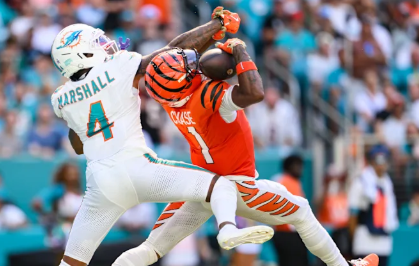
After Miami reduced the deficit to 21–10, the Dolphins needed a stop to build pressure. Instead, Burrow connected with Ja’Marr Chase for a 45-yard touchdown, pushing the score to 28–10. Jason Marshall Jr. was well positioned to challenge the pass, but Chase demonstrated why he is one of the league’s best receivers by making a remarkable one-handed catch as he fell into the end zone. The quick response cancelled Miami’s momentum and forced the Dolphins into an increasingly desperate chase for points.
Verdict
Miami’s second-half fight showed character, and the running game created several explosive plays, but the Dolphins lost because they made Cincinnati’s job too easy during the most important moments. Three turnovers, repeated field-position disadvantages and four touchdown passes from Burrow created a deficit that the late comeback could not overcome. The final score was close; for most of the afternoon, the contest was not.
The review cannot end there, though, because Willis is clearly the player under the greatest scrutiny after the loss. His first-half performance was poor, and it was slightly surprising that he was not benched. However, it is difficult to see what Miami would have gained by taking him out of the game. At present, the Dolphins appear to have acquired the Tennessee Titans version of Willis rather than the player who showed signs of progress in Green Bay. If he does not improve soon, Miami could face the unenviable prospect of considering a quarterback in the 2027 draft.
In fairness, he has not been helped by a receiving group that is struggling as a unit, but he is still leaving completions on the field. He takes downfield shots when they are not available and puts the offense behind schedule as a result. In effect, he remains inexperienced as a starter, but he has been in the league long enough to work on his craft behind the scenes. His pre-draft scouting report identified several weaknesses that remain relevant:
- Too many missed opportunities to make easy, on-schedule throws.
- Poor field recognition and progression quickness.
- Lack of touch greatly diminishes his margin for error as a thrower.
- Allows throwing windows to close on him.
- Accuracy plummets when scrambling.
There were many strengths alongside those weaknesses, but the concerns listed above remain visible. Willis completed 15 of 27 passes for 137 yards, with one touchdown and two interceptions, and his late fumble compounded the damage. If he cannot improve his processing, accuracy and decision-making quickly, his tenure in Miami could be short.