
OFFENSE NOT GOOD ENOUGH
Another missed opportunity...
Miami’s 19–9 defeat to Detroit offered encouragement on defense and frustration almost everywhere else. Against one of the NFL’s most dangerous attacks, the Dolphins competed physically and kept the contest within reach. Yet an offense that failed to score a touchdown, repeated penalties and costly special-teams mistakes ensured that defensive progress brought no reward.
1. Penalties: Miami kept getting in its own way
The headline figure was damaging enough: 11 penalties for 87 yards. Their timing made matters worse, with five coming in Detroit territory. A holding call wiped out a 50-yard completion from Malik Willis to Kevin Coleman Jr., turning a potential game-changing gain into another setback. Miami could not afford to keep surrendering ground when sustained offensive production was already so difficult. Detroit was hardly spotless, committing nine penalties of its own, but that only heightened the sense of an opportunity missed. For the Dolphins, discipline was not a side issue; it was central to why promising possessions failed to become touchdowns.
2. Offensive line: too little consistency up front
Miami’s offensive line did not provide a dependable platform for the offense. The Dolphins conceded three sacks for 23 yards and managed only 77 rushing yards on 21 attempts, an average of 3.7 yards per carry. Aaron Brewer was penalised twice for holding, while Austin Jackson drew a holding call and a false start. Those mistakes compounded an already difficult afternoon against Detroit’s front. Not every sack or unsuccessful run belongs solely to the line, but the overall picture was an offense struggling to sustain drives. Miami needed cleaner protection, fewer negative plays and more consistent running lanes—not simply the occasional successful snap.
3. Malik Willis: flashes were not enough
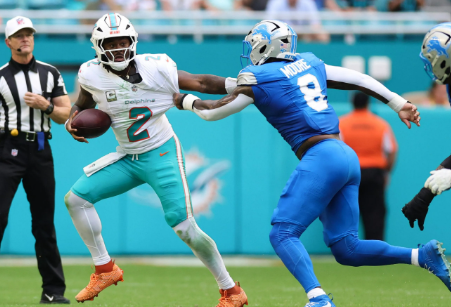
Willis finished 13-of-25 for 128 yards, with no touchdown passes and one interception. There were moments to build on, including his connection with Caleb Douglas, who caught six passes for 70 yards, and the long completion to Coleman that was erased by a penalty. Those plays show why the raw numbers do not tell the entire story. Nevertheless, an interception to Chuck Clark and an attack that finished without a touchdown leave important questions unanswered. Willis was not helped by the conditions around him, but he also did not produce enough to overcome them. This was neither a fair basis for writing him off nor a performance that settled Miami’s questions at quarterback. The interception shouldn’t have been thrown, there are times when it is worth a shot but that wasn’t one of them. As for his mobility, he did enough to evade a number of sacks but he is clearly hampered by the groin injury and was running at half speed when he had no option than to take off. The question is, should they sit him a few weeks to give him time recover.
4. Special teams: a big play could not hide basic errors
Bradley Pinion’s 46-yard completion to Kayton Allen on a fake punt supplied one of Miami’s most inventive moments. Zane Gonzalez also accounted for all nine Dolphins points, including a 52-yard field goal. But the unit’s mistakes were too significant to overlook: Gonzalez missed from 38 yards, Miami failed to put a kickoff into the landing zone, and Detroit converted a fake punt of its own. In a tight, low-scoring contest, those details carried extra weight. The missed kick alone did not explain a ten-point defeat, but the combined errors reduced Miami’s margin for recovery. The long returns by the opposition have dried up for the time being, which is a step in the right direction but the kicking game is not helping the overall performance.
5. Defensive improvement: the strongest reason for optimism
Miami restricted Detroit to 19 points and 270 total yards, recorded three sacks and ended Jared Goff’s 30-game streak with a touchdown pass. Rookie cornerback Chris Johnson contributed his first career interception, while the Lions converted only three of 12 third downs and scored one touchdown from four red-zone trips. Against the league’s top-ranked offense entering the game, that was meaningful evidence of progress. It was not flawless: Detroit converted all four fourth-down attempts, including Jahmyr Gibbs’ eight-yard touchdown run. Even so, this was a defensive effort capable of supporting a win. Miami has something to build on defensively, but until the offense and special teams stop undermining it, improvement will remain more visible in the performance than in the result.