
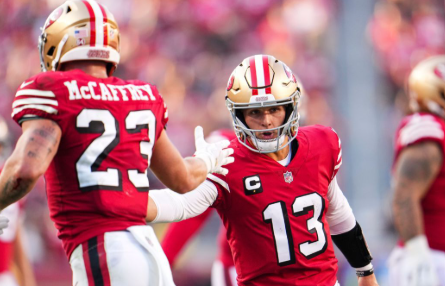
PURDY AND McCAFFERY LOOK TO FEAST
Get Achane going...
The Miami Dolphins and San Francisco 49ers arrive at this Week 2 matchup travelling in opposite directions. San Francisco opened with a commanding 27–7 win over the Los Angeles Rams, while Miami fell 27–13 to the Las Vegas Raiders. The 49ers are strong favourites at home, but an early-season game built around contrasting quarterbacks and explosive running backs still provides Miami with a glimmer of hope
1. Miami’s Protection Plan Against San Francisco’s Front
The first test is whether Miami can give Malik Willis enough time to operate. He threw for 220 yards in the opener, but the Dolphins produced only 259 total yards and committed two turnovers. San Francisco can create pressure with Nick Bosa while keeping Fred Warner central to its run fits and underneath coverage. Miami should favour quick throws, moving pockets and designed quarterback runs rather than asking its line to hold up in long-developing dropbacks. If the Dolphins are repeatedly placed behind the chains, the 49ers will dictate the game and as last week, things could ugly if Miami needs to throw the ball to catch up.
2. De’Von Achane Versus a Disciplined 49ers Defence
Achane remains Miami’s most dangerous weapon, yet he managed just 36 rushing yards on 11 carries in Week 1. Miami needs to manufacture touches through outside runs, screens and option plays that force San Francisco’s linebackers to defend the full width of the field. The challenge is that Warner’s range allows the 49ers to close space rapidly. Achane needs to be feed the ball more, even if it is to keep San Francisco from attacking Willis on every passing down.
3. Can Miami Contain Christian McCaffrey?
McCaffrey rushed for 68 yards on 10 carries in the opener and, as always, his influence extends far beyond the box score. San Francisco uses motion and varied personnel to reveal coverages, create leverage and turn McCaffrey into either a runner or receiver after the snap. Miami must tackle cleanly and maintain assignment discipline, particularly on the edges. Overcommitting extra defenders to the backfield will put stress on the defense and could open up holes behind the linebackers for Brock Purdy to exploit.
4. Brock Purdy’s Efficiency Against Miami’s Coverage
Purdy began the season with three touchdown passes, completing 25 of 34 attempts for 205 yards. Miami allowed a 70 per cent completion rate in its opener, a concern against an offence designed to create defined reads and yards after the catch. The Dolphins need to disrupt timing with pressure and contested throwing windows rather than relying on passive coverage. Applying pressure on Purdy could be a major problem, the defense didn’t have much success last week and will be without Chop Robinson, not that he was effective, but theoretically he is the team’s best pass rusher. Jeff Hafley needs to scheme something up otherwise it is going to be a very long day.
5. Turnovers, Third Downs and Game Script
Miami cannot afford to fall behind. The Dolphins ran only 45 offensive plays against Las Vegas, earned seven first downs and gave the ball away twice. That combination limits possessions and exposes a defence to sustained pressure. Miami’s upset formula is straightforward: protect the football, convert manageable third downs and either score first or stay within one possession into the fourth quarter. If San Francisco establishes an early two-score lead, its balanced offence and home-field advantage should make the comeback task extremely difficult.
Outlook
San Francisco holds the clearer advantage; they are a well-balanced team with an offensive wizard calling the plays. They will look to target the Dolphins weaknesses which there are many and create mismatches at every opportunity. Miami can make the matchup competitive by using Willis and Achane creatively, but it must play a cleaner and more efficient game than it did in the opener, penalties may be their downfall. All the pundits predict a win for the 49ers and there is no reason to dispute that.